A six-day Kenya safari suits travelers who want a focused route and substantial time in a few wildlife areas. Eight days adds a wider mix of habitats and the Maasai Mara. Fourteen days allows a deeper northern Kenya, Rift Valley and Mara circuit. Choose by the wildlife you most want to see, your tolerance for transfer days, and the time you can spend at each stop.
On a map, adding another destination can look irresistible. In a safari vehicle, the calculation changes. Every change of camp involves packing, checking out, traveling, checking in and learning a new landscape. A route with more park names can leave less time for the slow, absorbing work of watching wildlife.
That is why we compare itineraries by full safari days, not just calendar days. Our published 6-day Kenya safari focuses on Aberdare, Ol Pejeta and Samburu. Our 8-day Kenya safari travels from Nairobi to Samburu, Lake Nakuru and the Maasai Mara. The 14-day Kenya safari extends the journey across northern Kenya, the Rift Valley and the Mara. These are different route choices, not the same short safari with extra nights attached.
Kenya safari itinerary: 6, 8 or 14 days?
Decision factor
6 days
8 days
14 days
Published route
Nairobi → Aberdare → Ol Pejeta → Samburu → Nairobi
Nairobi → Samburu → Lake Nakuru → Maasai Mara → Nairobi
Nairobi, Ol Pejeta, Samburu, Mount Kenya, Lake Nakuru, Lake Naivasha and Maasai Mara
Nights
5
7
Confirm the exact night allocation in the final itinerary
Main strength
A focused northern Kenya experience
Northern wildlife, Rift Valley birdlife and classic Mara game viewing
A broader circuit with more opportunities to vary pace and experiences
Mara included?
No
Yes
Yes
Best suited to
Travelers drawn to rhinos, conservation and Samburu’s distinctive wildlife
First-time visitors who want contrasting habitats and the Mara
Travelers with time for a fuller Kenya journey
Main trade-off
No Mara on the published route
Several substantial road transfers
More total travel days and a larger overall trip commitment
The route and duration details above reflect our published six- and eight-day product pages and the published description of our fourteen-day circuit. Before booking, we confirm the exact fourteen-day night allocation, accommodation and transfer schedule in your tailored proposal.
There is no universal “ideal” safari length. Six days can feel generous when you concentrate on a few places; fourteen can feel rushed if you try to visit everything Kenya offers. The quality of the route matters more than the size of the number in its title.
What fits into a six-day safari?
Our six-day journey is deliberately not a compressed Maasai Mara safari. It travels north from Nairobi, beginning in Aberdare’s highland forest, continuing to Ol Pejeta Conservancy and ending with three nights in Samburu National Reserve. That final three-night stay is important: it gives you more than a quick introduction to Samburu before the return journey.
Aberdare offers a quieter beginning. Rather than racing straight into a full game-drive schedule, guests can watch for wildlife around the lodge waterhole and settle into the rhythm of the trip. Ol Pejeta then changes the emphasis to conservation, with rhino viewing and a visit to the chimpanzee sanctuary included in the published itinerary. Samburu brings a markedly different dry-country landscape along the Ewaso Nyiro River.
The route appeals to travelers interested in Kenya beyond its most familiar grasslands. In Samburu, the wildlife possibilities include Grevy’s zebra, reticulated giraffe, Beisa oryx, gerenuk and Somali ostrich, the animals often grouped as the “Samburu Special Five.” Sightings depend on conditions and the animals’ movements, but the chance to look for species associated with northern Kenya gives this journey a distinct identity.
Where the time goes
The six days include the outward journey from Nairobi, moves between Aberdare, Ol Pejeta and Samburu, and a return to Nairobi on Day 6. Our itinerary places three nights in Samburu, allowing full days for game drives and the planned Reteti Elephant Sanctuary visit. It also states that the journey uses a private 4x4 safari Land Cruiser and includes park entrance fees; some expenses, including international flights, drinks, gratuities and Day 6 lunch, are excluded.
That mix makes the six-day route a strong choice if you would rather know a smaller number of places well than make a brief appearance in every famous park. Its limitation is equally clear: the Maasai Mara is not included. If seeing the Mara is essential, choose a different route or ask us to redesign the itinerary rather than assuming two extra days can simply be added at the end.
Who should choose six days?
This is a particularly good fit for:
Travelers whose main interests are rhinos, conservation, and northern Kenya.
Repeat visitors who have already spent time in the Mara.
Families or couples who prefer a private, focused route.
Photographers drawn to contrasting forest and dry-country settings.
Guests with a firm six-day window who do not want to overpack it.
For a first safari, six days can absolutely be enough, provided the destinations match your priorities. If the Mara is the image that brought you to Kenya, our published eight-day route may be the more satisfying starting point.
What do eight days add?
Our eight-day itinerary is a different journey rather than an extension of the six-day product. It begins with a night in Nairobi, travels to Samburu for two nights, continues to Lake Nakuru, reaches the Maasai Mara for two nights, and returns to Nairobi before departure. It does not include Aberdare or Ol Pejeta on its published route.
The result is greater geographic variety. In Samburu, the landscape and wildlife introduce northern Kenya. Lake Nakuru provides Rift Valley scenery and birdwatching, alongside the possibility of seeing rhinos and other mammals. The Mara then brings open plains, predators, and the scale many first-time visitors hope to experience. Our published itinerary also includes a Maasai cultural visit and a nature walk.
Two additional days do not eliminate travel. This route moves between widely separated areas, and its Day 5 transfer into the Mara leaves one full game-drive day there before the return to Nairobi. If your sole priority is spending long, patient days in the Mara, we would discuss a more Mara-focused version rather than treating this route as the only eight-day option.
The advantage of contrast
For many first-time travelers, eight days offers a persuasive balance. The trip does not ask one destination to represent all of Kenya. Samburu’s dry-country setting, Nakuru’s lake landscape and the Mara’s grasslands each contribute something different.
That variety can be especially valuable for a group with mixed interests. One traveler may want big cats, another may care deeply about birds, and someone else may find the changing landscapes as memorable as the game drives. An eight-day circuit gives each interest a place without extending the holiday to two weeks.
The published eight-day package states that it uses an exclusively allocated tour Land Cruiser with guaranteed window seats, includes park and reserve entry fees, and provides bed and breakfast in Nairobi with full board on safari. International flights, drinks, laundry, gratuities, and specified optional activities are not included. We would confirm the final accommodation choices and the rate applicable to your group and dates before reservation.
Should you add more Mara time?
Possibly. If migration-season wildlife or Mara photography is the central purpose of your journey, the published allocation of two Mara nights deserves a closer look. An extra night can create more room for changing conditions and a less hurried game-viewing pace; it cannot guarantee a river crossing.
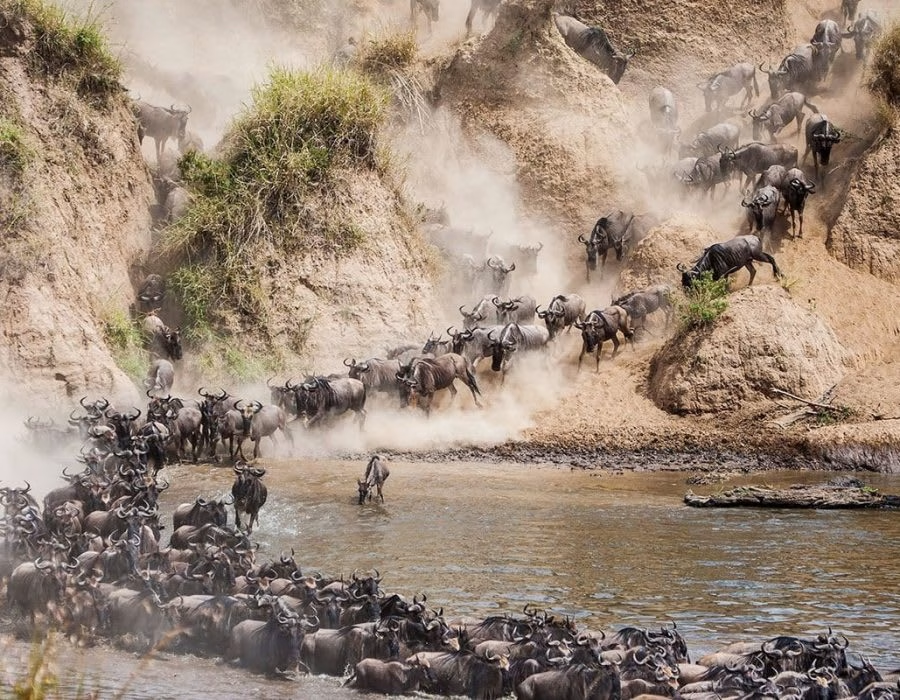
The Mara River migration phase is broadly associated with July through October, as the herds move in search of water and grazing. That seasonal window is useful for planning, but it is not a timetable for animal behavior.
Why fourteen days changes the journey
At fourteen days, you can begin to experience Kenya as a sequence of ecosystems rather than a shortlist of highlights. Our published fourteen-day circuit links Nairobi, Ol Pejeta, Samburu, the Mount Kenya area, Lake Nakuru, Lake Naivasha and the Maasai Mara. The attraction is not simply the number of stops: it is the opportunity to understand how different northern, highland, Rift Valley and Mara landscapes fit together.
Ol Pejeta brings a conservation focus. Samburu shifts the scene north. The Mount Kenya area adds a highland setting, while Nakuru and Naivasha give the Rift Valley more than a passing glance. By the time you reach the Mara, you have seen several very different versions of Kenya.
A fourteen-day itinerary also gives us more choices about pace. We can discuss where an additional night would add genuine value, where a road journey is part of the experience, and where a flight might spare you a tiring transfer. Those choices must be made against the actual route and your dates; a longer trip is not automatically relaxed if it has too many one-night stays.
More time should mean more depth
A common planning error is to see fourteen days as permission to add every available destination. That can produce a long list of park names but little time in any of them.
Instead, we ask what you want the additional days to accomplish. They might allow:
A slower start after an international arrival.
More than one full wildlife-viewing day in a priority area.
Time for a conservation visit, birding or another special interest.
A less demanding transfer schedule for children or older travelers.
A deliberate mix of lodge and tented-camp experiences.
Greater flexibility for photography and unhurried mornings.
For guests interested in the difference accommodation makes, our luxury tented camp versus safari lodge guide explains the practical trade-offs. On a longer circuit, the most rewarding choice may be a mix of both rather than the same style every night.
When fourteen days is worth it
Choose fourteen days if the journey itself is a major part of your holiday. The longer route particularly suits travelers coming to Kenya for a substantial once-per-trip break, people with varied wildlife interests, and guests who want the north, Rift Valley and Mara without reducing each to a photograph taken between transfers.
It can also suit families and photographers, but only when we plan the daily rhythm around them. A family may value a pool and a free afternoon more than another early start. A photographer may prefer an extra night in one location over a new destination. We tailor those decisions rather than assuming that more days should always mean more places.
If your available time includes the international flight into and out of Kenya, tell us that at the outset. “Fourteen days away” and “fourteen safari days on the ground” produce very different itineraries.
Compare total value, not headline price
A six-day package is not automatically cheaper per day, and a fourteen-day trip is not automatically better value. The routes differ, as do the accommodation possibilities, transport arrangements, group sizes and inclusions.
Our published six-day route is private and focused on Aberdare, Ol Pejeta and Samburu. The eight-day route covers Samburu, Lake Nakuru and the Mara, with a Nairobi night at each end. Comparing their displayed product prices without comparing those differences would not be a like-for-like assessment.
Ask these questions before deciding:
Question
Why it affects value
How many nights are spent in the places I most want to see?
A longer trip can still offer too little time in your priority park.
How many days involve a substantial transfer?
Transfers are necessary, but they reduce time available for game drives and rest.
Is the vehicle private or shared?
Vehicle arrangements affect flexibility, seating, and the final per-person quote.
Which meals are included?
A Nairobi hotel night may have a different meal basis from safari accommodation.
Are park and conservancy fees included?
These can materially change the total cost.
Which activities are included, and which are optional?
A listed experience is not necessarily part of the base rate.
Where are the camps located?
A convenient camp can save daily travel time to wildlife areas.
Are flights needed or useful?
Flying can save time but adds another cost and luggage requirements.
We also consider the cost of getting to Kenya. If your international travel consumes a substantial part of your overall holiday budget, staying longer may make that journey feel more worthwhile. But length should serve your interests, not become a reason to keep adding destinations.
For a fuller look at the transport decision, read our road safari versus fly-in safari to the Masai Mara comparison. The best transfer choice depends on the complete route, not the price of one flight.
Choose by the experience you want
The fastest way to choose is to start with a must-see list, and keep it short.
Choose six days if northern Kenya, Ol Pejeta’s conservation experiences and substantial Samburu time matter more to you than reaching the Mara. This is a focused private route, not a miniature version of a country-wide tour.
Choose eight days if you want Samburu, Rift Valley birdlife and the Mara in one published itinerary, and you are comfortable with the transfer days that connect them. It is an appealing first-safari route for travelers who value variety.
Choose fourteen days if you want a deeper circuit encompassing northern Kenya, the Mount Kenya area, the Rift Valley and the Mara, with room to discuss how much time each deserves. Ask us to confirm the exact night allocation before deciding whether the published route matches your preferred pace.
If none of those answers feels quite right, that is useful information. We can reshape the route, for example, spending longer in the Mara, reducing the number of stops or choosing flights for selected legs, rather than asking you to accept an itinerary built for somebody else.
Compare 6, 8 and 14-day itineraries
Tell us your available dates, whether those dates include international travel, your group size, and the three experiences you most want from Kenya. We will compare the relevant routes, identify where your time goes and provide a tailored quote with accommodation, transport, vehicle arrangements, fees and inclusions made clear.
Yes, if you want a focused experience and accept that you cannot see every region. Our published six-day route covers Aberdare, Ol Pejeta and Samburu, with three nights in Samburu; it does not include the Maasai Mara. If the Mara is essential to your first trip, ask us to compare another route.
How many parks should I visit in eight days?
Aim for a route that leaves time to experience each major stop. Our published eight-day itinerary combines Samburu, Lake Nakuru and the Maasai Mara, with Nairobi arrival and departure nights. Its variety is appealing, but the transfers are an important part of the schedule.
Does a fourteen-day safari feel too long?
Not when the route is paced around your interests and includes enough time in the destinations you care about. Fourteen days can feel rushed, however, if it becomes a string of one-night stays. We review the precise night allocation and travel days with you before recommending it.
Which itinerary length offers the best value per day?
There is no reliable answer without comparing dates, accommodation, transport, vehicle arrangements, fees and included activities. A focused six-day safari may give you more time in your preferred landscape; a longer journey may offer more variety. We provide a like-for-like quote so you can judge value by the experience, not only the daily rate.
Choose a Kenya-only safari for more wildlife time, simpler logistics, and deeper coverage of distinct ecosystems within 10–14 days. Choose a multi-country East Africa safari when a specific second-country experience - such as the Serengeti, Zanzibar or gorilla trekking—justifies extra flights, border formalities, and cost. Compare nights actually spent on safari, not the number of countries on your itinerary.
East Africa is not one safari experience. It is a collection of extraordinary landscapes, cultures and wildlife regions spread across several countries, each with its own parks, travel requirements, flight patterns and accommodation styles.
That variety makes a multi-country safari tempting. A traveler can imagine the Maasai Mara and Serengeti in the same journey, or pair a Kenya safari with a Zanzibar beach stay or gorilla trekking in Uganda or Rwanda. These combinations can be remarkable. They can also become rushed when too many destinations are fitted into too few days.
For most travelers with 10 to 14 days, the central decision is not whether one country is “better” than two. It is whether additional travel complexity will add a meaningful experience or simply reduce the time you have in the wilderness.
A Kenya-only itinerary can take you from the dry northern landscapes of Samburu to Ol Pejeta’s rhino conservation work, through the Rift Valley and into the Maasai Mara. A multi-country itinerary can bring together Kenya and Tanzania, add a beach extension, or connect a safari with a gorilla trek. The right choice depends on your priorities, pace, and budget.
Kenya-only vs multi-country: the 10–14-day comparison
Decision factor
Kenya-only safari
Multi-country East Africa safari
Travel pace
More relaxed, with fewer flight, road, and border transitions
Faster-paced, with more moving parts between destinations
Wildlife depth
Time to experience Kenya’s varied ecosystems in greater detail
Broader regional variety, but fewer nights in each individual area
Logistics
One set of entry requirements, one primary operating structure and fewer transfers
Additional flights, border procedures, travel documents and supplier coordination
Ideal length
Excellent for 8–14 days
Best from 12–14 days; shorter trips need tight focus
Best for
First-time safari travelers, families, photographers and guests who value a slower rhythm
Repeat safari guests or travelers with one specific second-country priority
Cost drivers
Accommodation, private guiding, park fees, domestic flights and road transfers
All Kenya cost drivers plus regional flights, additional park fees, visas or entry approvals and cross-border transfers
Sample highlights
Samburu, Ol Pejeta, Lake Nakuru, Lake Naivasha, Amboseli and Maasai Mara
Kenya plus Serengeti, Ngorongoro, Zanzibar, Uganda or Rwanda
Main risk
Trying to include too many Kenyan parks
Losing too much safari time to flights, border crossings and one-night stays
A Kenya-only itinerary is not a compromise. Kenya has the range to fill two weeks with genuine variety: elephant country below Mount Kilimanjaro in Amboseli; rare northern species in Samburu; rhino conservation in Ol Pejeta; Rift Valley lakes; and the Maasai Mara’s grasslands and big-cat viewing.
A multi-country safari becomes worthwhile when the second country adds something Kenya cannot provide in the same way. The Serengeti’s vast plains, Zanzibar’s Indian Ocean coast, and gorilla trekking in Uganda or Rwanda are all strong reasons to expand the map—but only when there is enough time to experience them properly.
What a deeper Kenya safari can include
Kenya rewards travelers who stay long enough to move beyond the most familiar itinerary. The Maasai Mara is essential for many first-time visitors, particularly during the July-to-October migration period, but it is only one part of the country’s safari story.
A well-paced 10- to 14-day Kenya safari can connect several contrasting regions without turning every other day into a transfer day.
Northern Kenya: Samburu and the arid north
Samburu offers a dramatic contrast to the Mara. The landscape is drier, more rugged and shaped by the Ewaso Nyiro River. It is known for species that are less commonly encountered farther south, including Grevy’s zebra, reticulated giraffe, Somali ostrich, gerenuk and Beisa oryx.
For travelers who want wildlife variety rather than a single migration-focused safari, the north gives a Kenya itinerary greater depth. It is particularly rewarding for photographers, repeat safari guests and travelers interested in landscapes as much as large concentrations of animals.
Ol Pejeta: conservation and rhino
Ol Pejeta adds a conservation dimension to a Kenya journey. It is a strong choice for guests interested in rhino, chimpanzee conservation, private conservancy management and a different style of game viewing from the Mara.
It can also break up a road route between Nairobi and northern Kenya, or fit naturally into a fly-in circuit. For families and multigenerational groups, this variation in habitat and activity can make a longer itinerary feel more balanced.
The Rift Valley: lakes, birdlife and a change of pace
Lake Nakuru, Lake Naivasha and surrounding Rift Valley landscapes introduce another side of Kenya: lakeshore scenery, birdlife, boat excursions, walking opportunities in appropriate areas and a welcome visual change from open savannah.
Not every itinerary needs all of these locations. The aim is not to collect parks. It is to create contrast while giving each stop enough time to be meaningful.
Amboseli: elephants and Kilimanjaro views
Amboseli is a compelling addition for travelers who want to see large elephant herds against the backdrop of Mount Kilimanjaro when conditions allow. It pairs particularly well with the Maasai Mara for a first Kenya safari because the landscapes, wildlife viewing and photographic opportunities feel distinct.
Maasai Mara: big cats and migration-season drama
The Maasai Mara remains one of the most compelling conclusions to a Kenya circuit. It offers open grasslands, abundant resident wildlife and some of East Africa’s most celebrated big-cat viewing.
During the annual migration period, typically associated with July to October in the Mara, it may also host large herds of wildebeest and zebra moving through the wider ecosystem. River crossings remain unpredictable, however. They are driven by herd movement, rainfall, water levels and animal behavior—not by an itinerary date.
Our 14-day Kenya safari shows what a deeper country-wide circuit can look like, linking Nairobi, Ol Pejeta, Samburu, Mount Kenya, Lake Nakuru, Lake Naivasha and the Maasai Mara. This is the kind of route that gives each ecosystem a clear role rather than treating Kenya as a brief stop before moving on.
When a second country adds real value
A multi-country East Africa safari should begin with a specific reason to cross a border.
“Seeing more countries” is not, by itself, a good enough reason. The strongest itineraries are built around experiences that are genuinely distinct and personally important.
Kenya and Tanzania: Mara, Serengeti and Ngorongoro
A Kenya-and-Tanzania itinerary is the most natural multi-country safari combination. The Maasai Mara and Serengeti are connected ecosystems, but they are not interchangeable. The Serengeti offers exceptional scale and different seasonal migration perspectives, while the Ngorongoro Conservation Area brings a distinctive crater setting and a different wildlife-viewing rhythm.
This route is best for travelers who:
Have at least 12 to 14 days available
Want to experience both sides of the wider migration ecosystem
Are comfortable with additional flights or a cross-border road transfer
Are prepared for higher total costs and more logistical detail
Value a broader regional story over a slower Kenya-only itinerary
A 10-day Kenya-and-Tanzania safari can work, but only if it is tightly focused. Attempting Nairobi, Amboseli, Maasai Mara, Serengeti, Ngorongoro and Zanzibar in 10 days usually creates too many transitions and too few full safari days.
The Serengeti borders Kenya’s Maasai Mara to the north, allowing wildlife to move through the wider ecosystem during the migration. That ecological continuity is one reason the combination is compelling—but it does not remove the practical travel steps required for guests crossing from Kenya into Tanzania.
Kenya and Zanzibar: safari plus beach
A Kenya-and-Zanzibar itinerary is ideal for travelers who want to end a wildlife-focused holiday with several nights by the ocean. This is particularly popular for honeymooners, couples, and guests who prefer a balance between early safari mornings and unstructured beach time.
The key is to protect the safari portion of the trip. We generally recommend at least six to eight nights in Kenya before adding a beach stay, depending on how many regions you hope to cover. A three-night safari followed by a long beach extension can be enjoyable, but it is not the same as a deeper East Africa safari.
Kenya and Uganda or Rwanda: safari plus gorillas
Gorilla trekking is one of the clearest reasons to build a multi-country East Africa itinerary. It is not a substitute for a savannah safari; it is a wholly different wildlife encounter involving forest terrain, permits, hiking, and a more physically demanding day.
For travelers who value wildlife diversity and have 12 to 14 days, Kenya plus Uganda or Rwanda can be exceptional. But it needs careful planning around internal flights, trekking permits, fitness level, and luggage.
The East African Tourist Visa can simplify entry for eligible travelers visiting Kenya, Uganda and Rwanda. It is valid for tourism travel between those three countries for up to 90 days and costs USD 100, but it does not include Tanzania. Travelers must apply through the country of first entry and should always confirm requirements for their passport before booking.
Two routes, compared honestly
The following examples show how a 14-night holiday can be allocated. They are planning patterns, not fixed packages; we will tailor camp selection, vehicle format and flight arrangements around your dates and priorities.
Option 1: A 14-night Kenya-only circuit
Destination
Suggested nights
Why it earns its place
Nairobi
1
International arrival, recovery and a smooth start
Samburu
3
Northern landscapes and specialist wildlife
Ol Pejeta
2
Rhino conservation and varied conservancy experience
Lake Nakuru or Lake Naivasha
2
Rift Valley scenery, birdlife and a change of pace
Maasai Mara
4
Big cats, open plains and extended game-viewing time
Nairobi
1
International departure buffer
Flexible routing or extra Mara / Amboseli night
1
Protects pace and allows the route to reflect the traveler’s priorities
This itinerary provides room for full game-drive days rather than treating each destination as a one-night stop. It also makes it easier to adjust transport: road travel can work on selected sections, while domestic flights can be used where they save substantial time.
Option 2: A 14-night Kenya and Tanzania safari
Destination
Suggested nights
Why it earns its place
Nairobi
1
Arrival and pre-safari night
Maasai Mara
3
Kenya’s classic grassland safari experience
Transfer / regional flight
1
A realistic allowance for cross-border logistics
Serengeti
3
Broad plains and a different migration ecosystem perspective
Ngorongoro / Karatu
2
Crater access and a change of landscape
Zanzibar
3
Beach extension and time to slow down
Departure routing
1
Ensures the journey does not rely on an unrealistic same-day international connection
The second itinerary is broader, but it has fewer full wildlife days in each area. It works for guests whose priority is the combination of Mara, Serengeti, Ngorongoro and coast. It is not automatically superior to the Kenya-only route; it simply answers a different travel ambition.
What changes the quote?
A multi-country itinerary is usually more expensive than a Kenya-only safari, but the size of the difference varies significantly.
The major cost drivers are not only accommodation rates. They include the number of domestic or regional flights, park and conservancy fees, one-way vehicle transfers, entry authorizations, private guiding, room category and the number of nights spent at high-demand properties.
Kenya-only cost drivers
Camp or lodge level and location
Private versus shared vehicle
Domestic flights versus road transfers
Park and conservancy fees
Number of destinations and transfer distances
Room category, family arrangements and single supplements
Optional experiences such as ballooning, guided walks or cultural visits
Multi-country cost drivers
All Kenya-only factors, plus:
Regional flights or cross-border road transfers
Separate park fees and conservation fees in each country
Additional guiding teams, vehicles and operating partners
Visas, electronic travel authorizations or permits
Gorilla permits, where relevant
One-way routing and additional baggage considerations
Extra arrival or departure nights required to make the route sensible
Entry rules can change. Kenya requires most international visitors to obtain an approved Electronic Travel Authorization before travel, with specific exemptions and eligibility rules. We will guide you on the planning process, but each traveler remains responsible for meeting the current requirements for their own nationality and passport.
Do you lose safari time at borders?
You can, especially on an itinerary that relies on overland cross-border travel.
The issue is not merely time spent at immigration. It includes packing, departure from camp, road distance to the border, formalities, changing vehicles or guides where necessary, onward driving, and arrival procedures at the next accommodation. Even a smoothly managed transfer can consume a meaningful part of the day.
That does not mean overland border travel should be avoided. It can be a practical and scenic option for the right itinerary. But it should be treated honestly as a transfer day—not marketed as a full game-drive day with a quick border stop in the middle.
For travelers with limited time, regional flights can protect more safari hours. They increase the cost but often create a more relaxed journey. We assess this trade-off case by case.
Which option is better for a first safari?
For most first-time visitors with 10 to 14 days, we recommend a Kenya-only safari.
Kenya provides enough variation to make a first safari feel comprehensive: multiple ecosystems, varied wildlife, conservation experiences, high-quality camps and lodges, and the option to combine road travel with bush flights. A deeper Kenya itinerary also gives you time to understand the rhythm of safari—early starts, long quiet wildlife sightings, changing weather, camp life and the pleasure of not needing to rush onward every morning.
A multi-country route is the stronger choice when the second country contains a true priority:
You have always wanted to see the Serengeti.
A Zanzibar beach stay is essential to your holiday.
Gorilla trekking is a must, not an optional add-on.
You are returning to East Africa and want a broader regional comparison.
You have 14 days or more and are comfortable paying for extra logistics.
How we design the right East Africa safari
We begin with what matters most to you, not with a pre-set list of countries.
Tell us whether your priority is migration wildlife, big cats, elephants, rare northern species, conservation, photography, gorilla trekking, a beach extension, family travel or a relaxed luxury pace. We will then recommend the number of countries that adds value rather than complexity.
Choose a Kenya-only safari if you want deeper wildlife time, fewer transitions and a varied 10- to 14-day itinerary that does not feel rushed.
Choose a multi-country East Africa safari if a specific experience in Tanzania, Uganda or Rwanda is important enough to justify additional transfers, costs and planning.
A better safari is not the one that crosses the most borders. It is the one that gives you enough time in the landscapes and wildlife areas you care about, with realistic transfer days and the right standard of guiding and accommodation.
Share your travel dates, group size, budget range, and must-have experiences with us. We will build a clear Kenya-only and multi-country option where appropriate, showing the nights, flights, transfer requirements, inclusions and trade-offs before you decide.
Contact our safari specialists to compare tailored Kenya and East Africa safari itineraries, or message us on WhatsApp to begin planning.
FAQs
Is 10 days enough for Kenya and Tanzania?
It can be, but only with a focused itinerary. A well-designed 10-day trip might combine the Maasai Mara with the Serengeti and Ngorongoro, but it will involve several transfers and fewer nights in each location. For a more relaxed Kenya-and-Tanzania experience, we recommend 12 to 14 days.
Is a multi-country safari much more expensive?
Usually, yes, because regional flights, additional park fees, border logistics, extra guide and vehicle arrangements, and one-way routing add cost. The final difference depends on accommodation level, season, travel style, and the countries included. We will provide a like-for-like comparison rather than a headline price alone.
Do travelers lose safari time at the Kenya–Tanzania border?
They can. Border travel includes road transfers, immigration procedures, possible vehicle or guide changes, and onward travel to the next camp. It should be planned as a genuine transfer day. Flights can reduce travel time but may increase the overall itinerary cost.
Which option is better for a first safari?
For most first-time travelers with 10 to 14 days, a Kenya-only safari offers better depth, simpler logistics, and more time in wildlife areas. A multi-country safari is the better choice when you have a specific priority—such as the Serengeti, Zanzibar or gorilla trekking - that Kenya alone cannot provide.
The Giant Kingfisher is Africa’s largest kingfisher and a show-stopper at Lake Naivasha. According to BirdLife International, it remains widespread, though local declines can occur near polluted waters.
Giant Kingfisher facts at a glance
Scientific name: Megaceryle maxima. Largest African kingfisher by size.
Length: about 42–46 cm; weight: ~255–426 g.
IUCN status: Least Concern, with threats from pesticide runoff and occasional persecution at fish farms.
Habitat: rivers, lakes, estuaries, and well-wooded watercourses across sub-Saharan Africa.
Male vs female: quick ID
Male: bold chestnut breast band speckled white.
Female: white throat and breast; rufous belly band lower down.
Giant Kingfisher family group
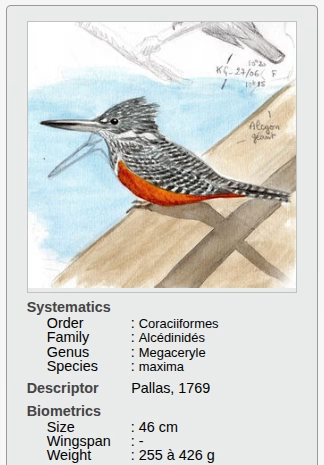
The Giant Kingfisher sits in order Coraciiformes and family Alcedinidae. It belongs to the big-water genus Megaceryle, alongside Belted, Ringed, and Crested kingfishers. Pied Kingfisher is close but in a different genus.
Quick taxonomy
Rank
Name
Family
Alcedinidae
Genus
Megaceryle
Species
Megaceryle maxima
This framework is consistent across major checklists used by recordists and field guides.
Image source: oiseaux.net
Subspecies of Giant Kingfisher
Two forms are recognized:
M. m. maxima – widespread in open waterways from West to East and southern Africa.
M. m. gigantea – a darker “forest race,” more barred below, in West and Central forest belts, overlapping near the forest edge.
Field birders at Lake Naivasha encounter Giant Kingfisher of the nominate group near open shores and river outlets. You can often compare it with Pied Kingfisher on the same perch, a neat family study during a bird watching in Naivasha session.
Where the Giant Kingfisher lives: world, Africa, and Kenya
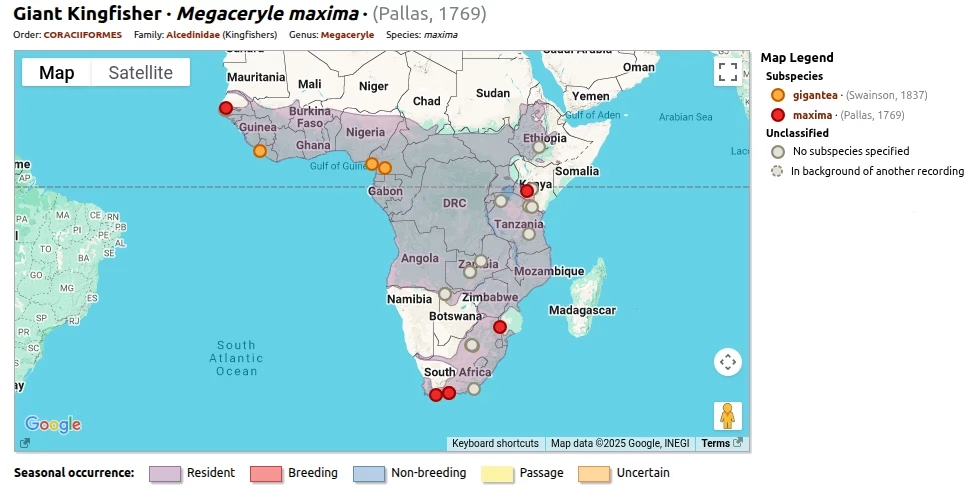
The Giant Kingfisher ranges across much of sub-Saharan Africa. It is a resident breeder on big rivers, lakes, and wooded watercourses, excluding the arid far southwest.
Two subspecies share that range. M. m. maxima spans Senegambia through Ethiopia to South Africa. M. m. gigantea holds the West and Central African forest belt to western Tanzania and northern Angola. Kenya hosts the nominate maxima.
In Kenya, the Giant Kingfisher occurs wherever deep, fish-rich waters meet sturdy perches. It is regular on Rift Valley lakes and along sizeable rivers. Around Lake Naivasha, expect it on overhanging branches and boat moorings.
Naivasha makes views easy. Boat outings often produce Pied and Giant Kingfisher side by side, with fish-eagles calling above. It’s a classic stop for birders, and a scenic one too.
Tip for planning: pair your lake session with a gentle walk on Crescent Island Naivasha for more waterside birding and photography.
“Necks of steel”: how the Giant Kingfisher dives without injury
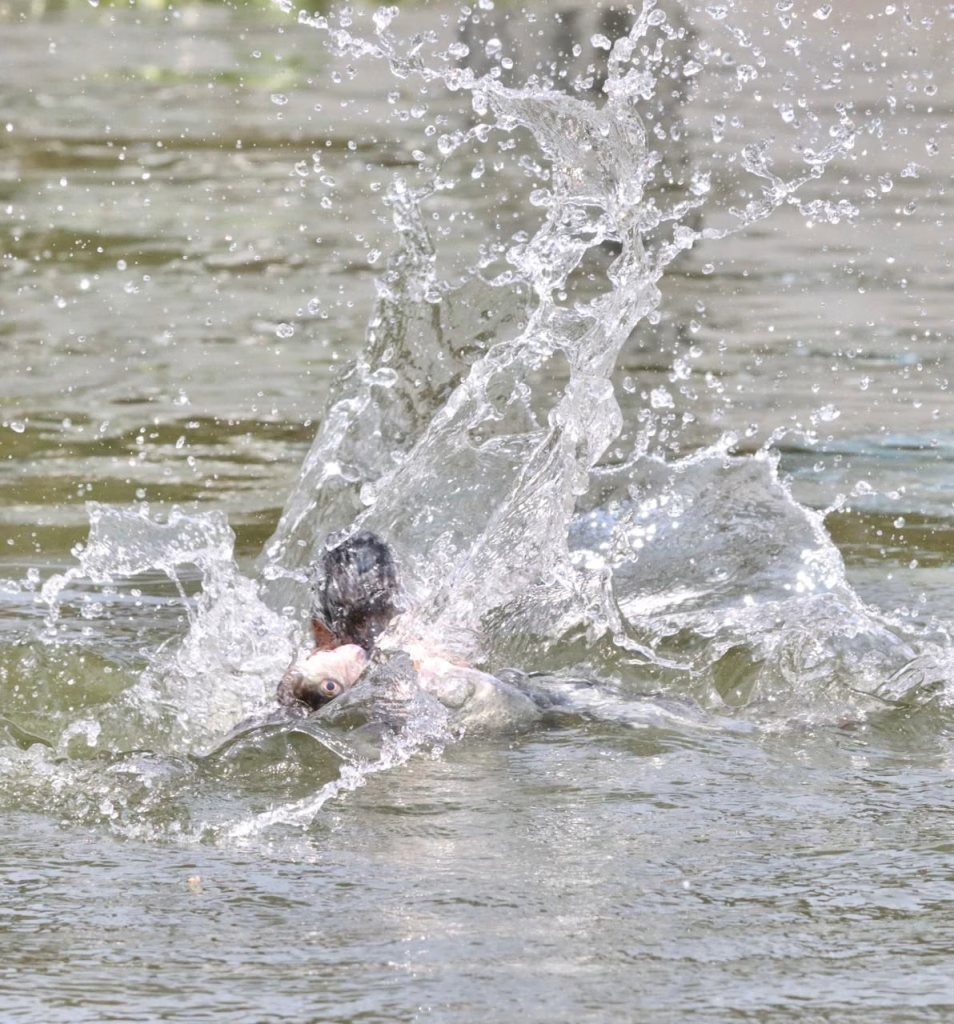
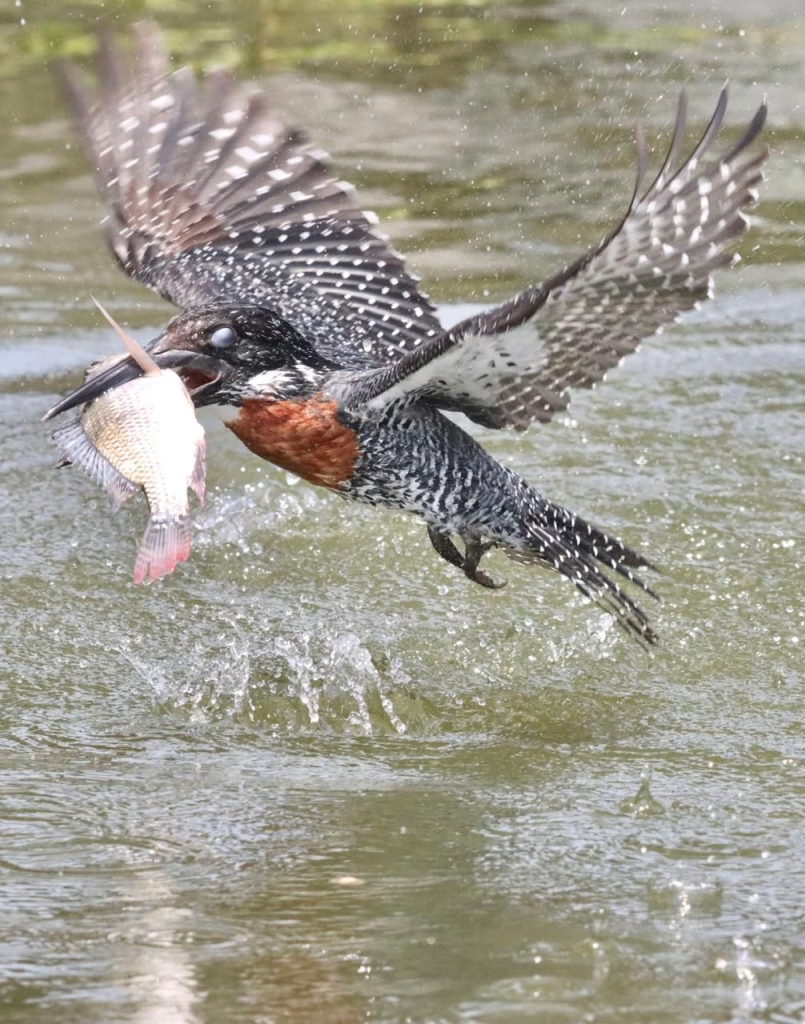
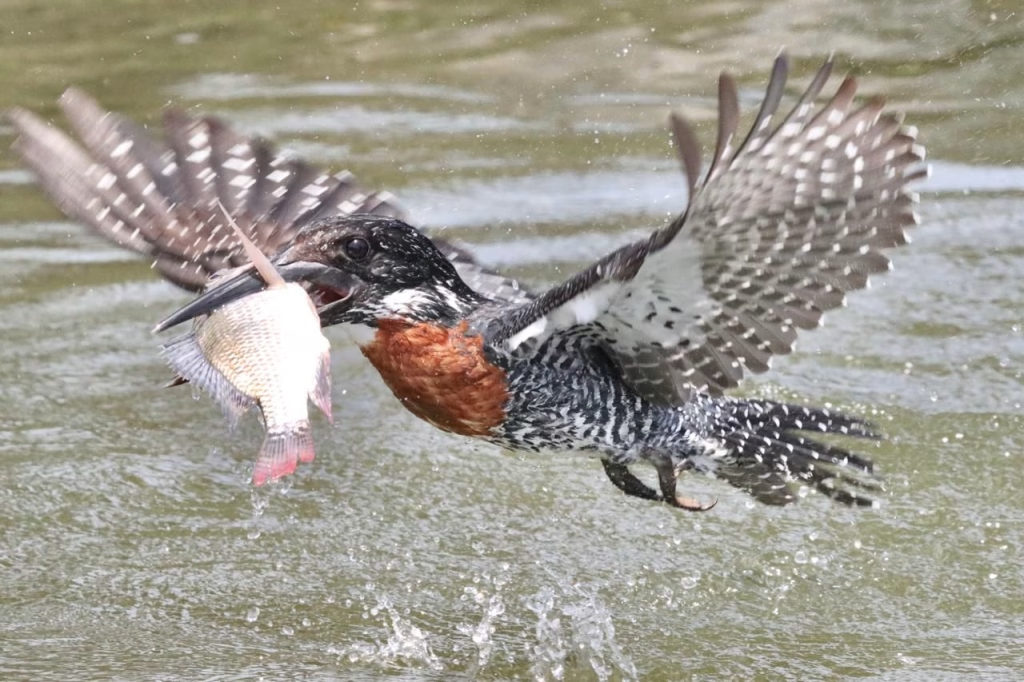
The Giant Kingfisher hits the water head-first at up to 25 mph. Yet it surfaces with a fish and no concussion. Researchers now link this feat to a set of physical and genetic adaptations.
Hydrodynamic beak. A long, narrow cone spreads impact forces and reduces drag at entry. Longer, slimmer bills cut resistance best.
Protective vision. A clear nictitating membrane slides over the eyes during the dive. The Giant Kingfisher can still see the strike underwater. Its lenses can refocus for underwater vision.
Controlled entry. Plunge-diving kingfishers manage body angle and head stability to pierce the surface cleanly. Few birds use this risky method.
Brain safeguards. Diving lineages show changes in genes tied to tau, retina, and blood vessel function. These may lower impact damage.
For photographers at Lake Naivasha, watch the perch-dive-return cycle. The Giant Kingfisher fixes a target, folds its wings, and spears the surface. The nictitating membrane helps it see the strike, then it returns to the perch to subdue prey.
Most birds would risk injury trying that headfirst impact. The Giant Kingfisher does it daily because evolution fitted the tools for the job.
Diet, nesting, and behavior you can witness at Lake Naivasha
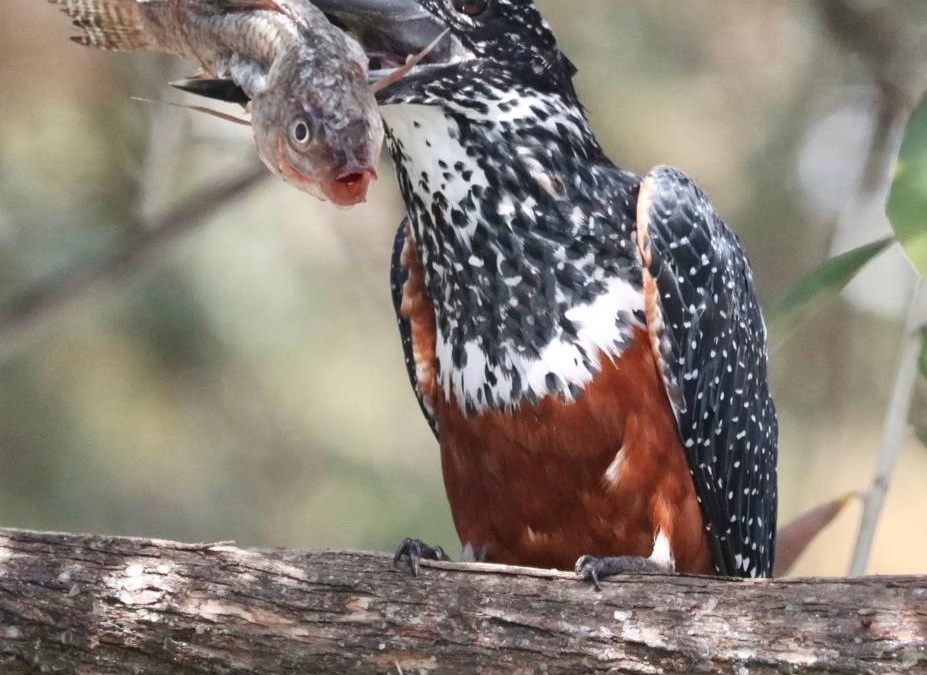
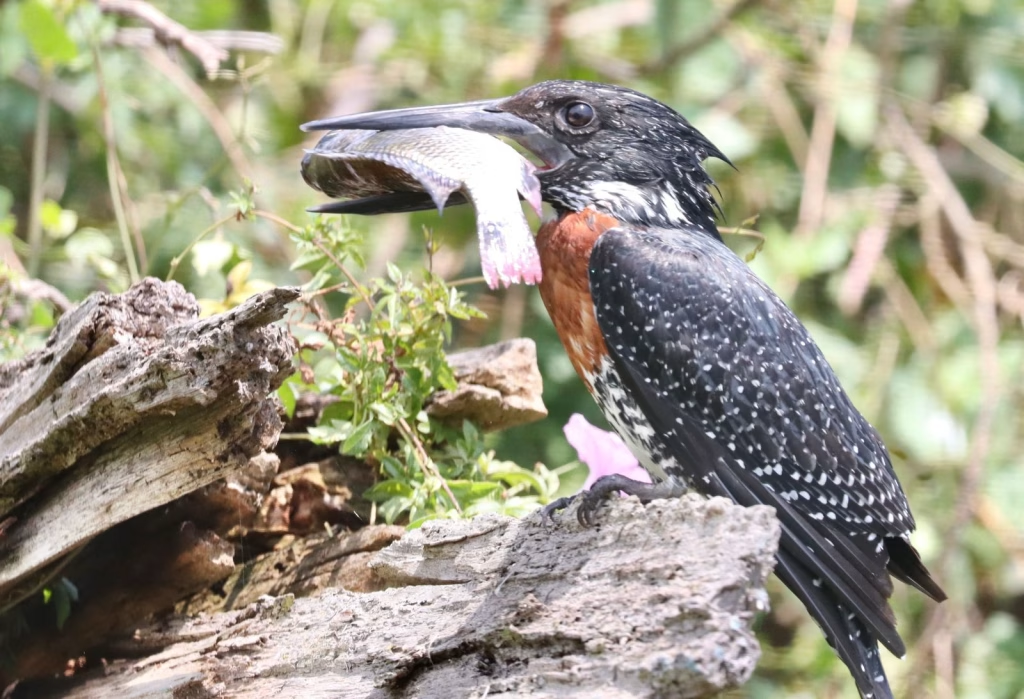
The Giant Kingfisher is a perch-and-plunge specialist. It hunts from posts, branches, and boat moorings, then dives to seize prey and returns to the perch to subdue it. At Lake Naivasha you can watch a Giant Kingfisher hammer a tilapia against wood to break the spine before swallowing.
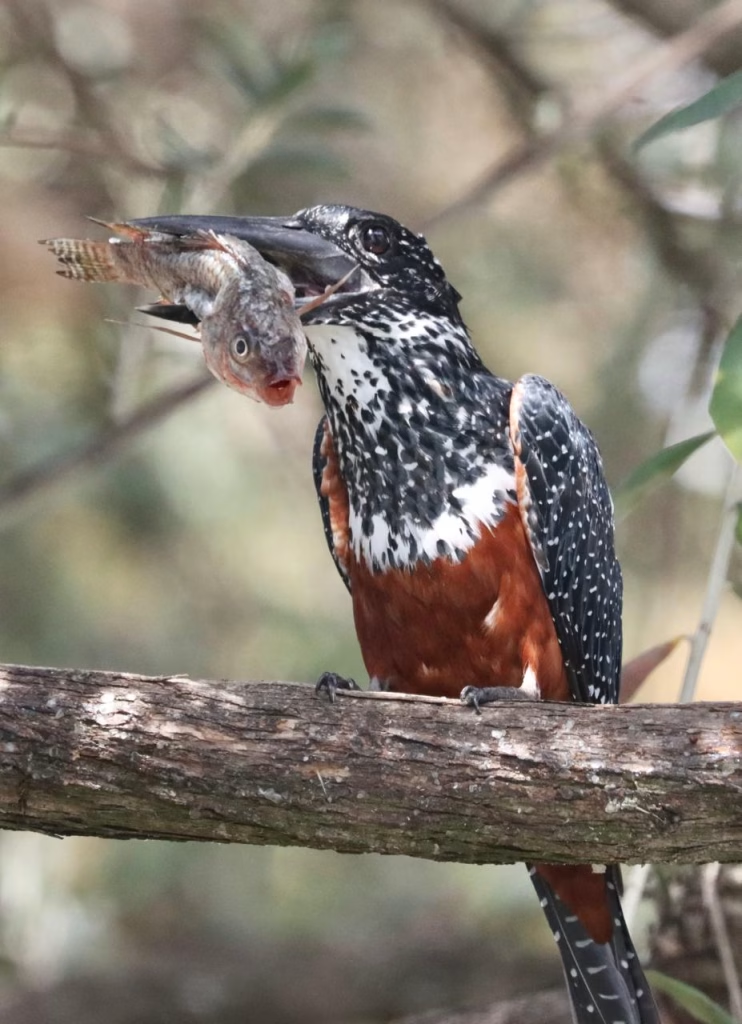
Diet. Fish dominate the menu, but the Giant Kingfisher also takes crabs and frogs, especially along rocky or reed-fringed shores. You may see it adjust prey head-first before gulping.
Nesting. The Giant Kingfisher excavates a long tunnel in a steep bank. Typical burrows run about two meters; an 8.5-meter tunnel has been recorded. Both sexes dig with their bills and feet.
Eggs and care. Most sources report clutches of three to five glossy white eggs. Both parents incubate and share feeding duties; incubation lasts roughly 25–27 days. Chicks then remain in the nest for several weeks before fledging.
Social life. The Giant Kingfisher is usually solitary. During breeding, pairs defend long stretches of river or lake edge and keep to leafy riparian perches.
Predators. Adults mostly face raptors. Eggs and chicks risk snakes and small carnivores raiding tunnels.
Pro tip for Naivasha: unlike hovering Pied Kingfisher, the Giant Kingfisher almost always hunts from a perch. Scan exposed posts and overhanging branches, then watch for that powerful, head-first plunge.
Why the Giant Kingfisher is a must-see for bird lovers
The Giant Kingfisher offers drama you can plan for and watch in full. It is bold, it is focused, and it performs in good light. For a birder or photographer, that mix is gold. For example, see these splendid sequential photos taken by one of Campo East Africa Safaris clients while on a tour of Lake Naivasha, Nakuru County, Kenya.
What makes the Giant Kingfisher unmissable
Big, blocky profile that stands out on posts and branches.
Clear, repeatable hunt routine you can learn and anticipate.
Explosive plunge that few birds could copy without harm.
Strong, rattling call that helps you pick a bird before you see it.
Boat access at Naivasha that brings you close yet keeps the bird relaxed.
How to get your best look
Find a perch the Giant Kingfisher uses, then wait.
Keep the sun at your back, and meter for a bright surface.
Use continuous focus and a fast shutter for the strike.
Watch the return to the perch; the victory shots happen there.
Stay quiet. Let the action unfold, and you will get more time.
Good birding ethics
Give nest banks space, and never flush a bird from a perch. Protect the moment for the Giant Kingfisher, and you protect your own chance at a second dive sequence. For general field ethics, see standard bird-photography guidance.
Where to see the Giant Kingfisher at Lake Naivasha
You can spot the Giant Kingfisher along calm shorelines, boat jetties, and overhanging acacia branches. South Lake’s quiet coves and papyrus fringes are prime. Boat rides increase your angle on low perches where the Giant Kingfisher hunts. Guides often find repeat perches that produce reliable views. The Giant Kingfisher is one of Naivasha’s most visible birds.
Micro-habitats to scan
Shaded branches above clear water, especially near reed lines.
Fishing posts and mooring poles used as hunting perches.
Time it right. Go at first light or late afternoon when glare softens.
Use a boat. Keep a low profile, drift, and let the Giant Kingfisher resume hunting.
Watch the routine. Perch → dive → return. The action peaks on the return.
Mind the background. Angle for open water behind the bird to isolate the subject.
Hold position. Avoid sudden moves near nest banks or active perches.
Pack smart. Binoculars, a 300–600 mm lens, polarizer, and a dry bag.
Travel logistics to see the Giant Kingfisher at Lake Naivasha
Plan your day so the Giant Kingfisher shows you its full routine. Light, access, and timing matter, and Naivasha makes it easy.
When to go
Dry months bring softer light and calmer water, which helps you track the Giant Kingfisher. Aim for June–September, plus January–February. Go at first light or late afternoon.
Getting there
Lake Naivasha sits about a two-hour drive from Nairobi on the Rift Valley escarpment. Private transfer or guided transport keeps gear safe and stress low. Campo EA Safaris
On the water
Use a quiet boat with a patient skipper. Drift near repeat perches and let the Giant Kingfisher resume hunting. Boats also steady your view in light chop.
What to pack
Binoculars, a 300–600 mm lens, high-speed cards, and a dry bag. A polarizer tames glare on the strike. Bring a light jacket; breezes can bite even on sunny days.
Stretch your legs on the Mount Longonot rim trail for huge Rift views after a Giant Kingfisher morning.
Field etiquette
Give nest banks space. Keep voices low near active perches. Small courtesies buy you longer, cleaner views of the Giant Kingfisher.
Why travel with Campo East Africa Safaris
When you want reliable views of the Giant Kingfisher, local expertise wins. Campo East Africa Safaris builds every Naivasha session around how the Giant Kingfisher actually hunts, so you spend more time watching and less time waiting.
Guiding that’s tuned to birds
Head guide and proprietor Julius Maina brings deep field experience and sharp spotting skills. He reads wind, water clarity, and perch use to place you where a Giant Kingfisher will dive and return. His calm, clear coaching keeps the boat steady and your shots clean.
Boats, skippers, and ethics that help you see more
Small boats with quiet motors let you drift near repeat perches without stress to the Giant Kingfisher. Photographers get space to work. Birders get time to observe the full routine. We keep nest banks off-limits and hold position so the bird resumes natural behavior, which means you see more action.
Beyond a tour
Research support and cultural insight shape how we guide, and it shows on the water. Read how Julius’ fieldwork mindset informs careful planning and logistics on our research support services page.
Plan your Giant Kingfisher trip
Ready to see the Giant Kingfisher do its head-first plunge? Let’s build a custom birdwatching safari around your target species, dates, and pace.
How we tailor it
Lake Naivasha boat sessions timed for repeat Giant Kingfisher dives.
Add Rift Valley lakes, highland forests, or coastal rivers to match your list.
Photo-led guiding, ethical distances, and flexible start times.
Lodges chosen for quick water access and dawn light.
Your next step
Tell us your dates and wish-list. We’ll design a private, bird-forward plan that fits your time and budget. Reach out via our Contact Us page to brief Julius directly.
Naivasha, located in Kenya’s stunning Great Rift Valley, is a renowned bird-watching destination. With its diverse habitats, including wetlands, acacia woodlands, and open savannahs, this region supports over 400 species of birds. From the shimmering waters of Lake Naivasha to the rugged cliffs of Hell’s Gate National Park, bird enthusiasts have countless opportunities to spot both resident and migratory species. Whether you're a seasoned ornithologist or a casual nature lover, Naivasha offers an unforgettable birding experience.
Why Naivasha is a Birding Paradise
Naivasha's location within the Rift Valley makes it an ecological hotspot. The interplay of wetlands, forests, and savannahs creates an ideal environment for both aquatic and terrestrial bird species. Furthermore, Naivasha acts as a crucial stopover point for migratory birds traveling between Europe, Asia, and Africa during the migratory season.
Malachite Kingfisher with its wings open
Here’s why bird watching in Naivasha is unmatched:
Diverse Habitats: The variety of ecosystems, including freshwater lakes, swamps, and dry scrublands, ensures a rich mix of bird species.
Proximity to Nairobi: Just a 90-minute drive from the capital, Naivasha is an accessible getaway for birding enthusiasts.
Seasonal Migrants: During the migratory season (October-March), species like the African spoonbill, flamingos, and storks join the resident birds, adding to the variety.
Year-Round Birding: Unlike some destinations, Naivasha offers excellent birding opportunities throughout the year.
Notable Bird Species in Naivasha
The range of birds in Naivasha is truly astounding. While some species are more elusive, many are easy to spot during boat rides, walking safaris, or even from the comfort of lakeside lodges. Here are a few highlights:
African Fish Eagle: Known as the “king of the lake,” this majestic raptor’s call is a signature sound of Naivasha. Its powerful dives to catch fish are mesmerizing to watch.
Kingfishers: Species like the Malachite, Pied, and Giant Kingfishers are frequently seen perched near the water, scanning for fish.
Great White Pelicans: These large, social birds can often be seen gliding effortlessly across the lake in search of food.
Crested Grebes: Known for their elaborate courtship displays, these birds are a treat for those lucky enough to spot them.
Yellow-Billed Storks: Often wading in shallow waters, these birds add vibrant splashes of color to the scenery.
Flamingos: While not as abundant as in Lake Nakuru, flamingos occasionally visit Lake Naivasha, especially during migratory periods.
Best Bird Watching Spots in Naivasha
1. Lake Naivasha
The lake itself is a haven for aquatic birds. A boat ride across its calm waters offers unparalleled opportunities to observe pelicans, cormorants, herons, and other waterfowl. Early mornings are especially magical, as the golden light enhances the serene environment and bird activity peaks.
2. Crescent Island Game Sanctuary
Accessible by boat, Crescent Island offers a peaceful setting where birds thrive undisturbed by vehicles. The sanctuary’s open spaces and acacia groves attract species like sunbirds, weavers, and egrets. Walking safaris here provide an intimate birding experience.
3. Hell’s Gate National Park
This park is home to dramatic cliffs that serve as nesting grounds for raptors such as Verreaux’s Eagles and Augur Buzzards. The park’s open grasslands are also frequented by ground birds like guinea fowls and francolins.
4. Elsamere Conservation Centre
Once the home of conservationist Joy Adamson, the gardens surrounding Elsamere are teeming with smaller bird species. It’s an excellent spot to relax and observe colorful birds like bee-eaters and woodpeckers.
When to Go Bird Watching in Naivasha
While Naivasha is a year-round birding destination, your experience can be enhanced by timing your visit during peak seasons:
October to March: This is the migratory season, when Naivasha sees an influx of species such as flamingos and Eurasian storks.
June to September: The dry season provides clear skies and better visibility for spotting resident birds.
The best times of the day for bird watching are early mornings and late afternoons, when birds are most active and the lighting is perfect for photography.
Tips for an Unforgettable Bird Watching Experience
To make the most of your birding adventure in Naivasha, consider these expert tips:
Pack the Right Gear: Binoculars with a magnification of at least 8x are essential for observing details. A birding guidebook or app can help you identify species on the spot.
Choose Comfortable Attire: Neutral-colored clothing reduces the chance of startling birds. A hat and sunscreen are also advisable.
Be Quiet and Patient: Birds are easily spooked by loud noises or sudden movements. Take your time and let the birds come to you.
Hire a Guide: Local guides know the best spots and can share fascinating details about the birds’ behaviors and habitats.
Bring a Camera: If you’re into photography, a zoom lens will help you capture stunning close-ups without disturbing the birds.
Conservation Efforts in Naivasha
Naivasha’s reputation as a birding hotspot is closely tied to ongoing conservation efforts. Local organizations and lodges work tirelessly to protect the fragile ecosystems that sustain bird life. Initiatives include:
Wetland Preservation: Preventing encroachment and maintaining water quality in Lake Naivasha.
Community Engagement: Educating locals about the economic benefits of eco-tourism.
Research and Monitoring: Regular surveys to track bird populations and migratory patterns.
Visitors are encouraged to support these efforts by practicing responsible tourism, such as avoiding single-use plastics and respecting wildlife guidelines.
Combine Bird Watching with Other Activities
Naivasha’s attractions go beyond birding. Make your trip even more memorable by exploring:
For a more extensive safari experience, consider adding the Maasai Mara or Lake Nakuru National Park to your itinerary.
Plan Your Bird Watching Safari with Campo East Africa Safaris
Discover the magic of bird watching in Naivasha with Campo East Africa Safaris. Our tailored tours provide access to the best birding spots, guided by experts who ensure you won’t miss a thing. Visit our Contact Us page to start planning your adventure today!
Rising dramatically above the Great Rift Valley, Mount Longonot is a dormant volcano offering one of Kenya’s most challenging yet rewarding hiking experiences. This natural wonder, located near Naivasha, attracts outdoor enthusiasts from all over the world. With its steep trails, breathtaking landscapes, and diverse wildlife, Mount Longonot is an adventure you’ll remember for a lifetime.
The Geology of Mount Longonot
Mount Longonot, whose name means "steep ridges" in Maasai, is a classic example of the geological forces that shaped the Rift Valley. Formed thousands of years ago, its massive crater measures approximately 7.5 kilometers in diameter. Walking along the rim of this extinct caldera offers not only physical exertion but also a rare glimpse into Kenya’s volcanic past.
The mountain’s lava flows are still visible, and its fertile volcanic soils support a variety of plants, creating a lush environment that contrasts with the surrounding savannah.
Why Hike Mount Longonot?
Mount Longonot offers something for everyone, from casual hikers to seasoned adventurers. Here’s why it’s a must-visit destination:
Incredible Scenery: The panoramic views from the crater rim stretch across the Rift Valley and include Lake Naivasha and beyond.
Wildlife Encounters: The park is home to zebras, giraffes, buffaloes, and numerous bird species.
Adrenaline-Pumping Trails: The steep ascent and rugged paths make this hike as thrilling as it is rewarding.
Eco-Tourism Highlight: Hiking Mount Longonot supports the conservation of this unique ecosystem, which is managed by the Kenya Wildlife Service (KWS).
The Hiking Experience
The Ascent to the Crater Rim
The hike begins at the Mount Longonot National Park gate, where visitors pay an entry fee (about Ksh 300 for locals and Ksh 2,000 for foreigners). The trail starts off with a gentle incline before transitioning into steeper sections. The ascent typically takes 1-2 hours, depending on your pace and fitness level.
Along the way, you’ll encounter volcanic rocks, open grasslands, and acacia trees. The higher you climb, the more expansive the views become, creating perfect spots for photo breaks.
Exploring the Crater Rim
Once you reach the rim, you’re greeted by stunning vistas of the crater floor below—a vast, untouched wilderness teeming with vegetation. Circumnavigating the rim is an optional but highly recommended adventure. The 7.2-kilometer trail around the crater offers 360-degree views and takes an additional 2-3 hours. Be prepared for narrow paths, steep sections, and thrilling drops.
Descending Mount Longonot
The descent is faster but still requires caution, especially on loose gravel. Many hikers complete the entire journey, including the crater rim loop, in 5-6 hours.
Wildlife and Flora
Mount Longonot National Park is more than just a hiking destination; it’s a thriving ecosystem. As you explore the trails, keep an eye out for:
Zebras, Giraffes, and Antelopes: These iconic animals are often spotted grazing in the park.
Buffaloes and Warthogs: Though less common, these species add an element of surprise to the hike.
Birdlife: From eagles soaring overhead to colorful weaver birds, the park is a paradise for bird watchers.
Unique Vegetation: The mountain’s fertile soils support a mix of grasses, shrubs, and trees, including hardy acacias.
Best Time to Visit
Mount Longonot is accessible year-round, but the dry seasons are ideal for hiking.
January to February: Warm, dry weather with clear skies.
June to October: Cool and dry, perfect for long treks.
During the wet season (March-May and November), the trails can become slippery and challenging to navigate.
Practical Tips for Hiking Mount Longonot
To make the most of your adventure, consider the following tips:
Pack Wisely: Bring water, energy snacks, sunscreen, a hat, and a camera.
Dress for the Terrain: Comfortable, sturdy shoes and breathable clothing are essential.
Start Early: Arrive at the park gate by 7:00 AM to avoid the midday heat and crowds.
Hire a Guide: Though not mandatory, guides provide valuable insights and enhance your safety.
Go at Your Own Pace: The steep sections can be tough, so take breaks when needed.
Extend Your Adventure
Mount Longonot is a gateway to other exciting destinations in the Naivasha region:
Mount Longonot is part of Kenya’s network of protected areas managed by KWS. Entry fees contribute to wildlife protection, anti-poaching initiatives, and trail maintenance. Visitors are encouraged to follow Leave No Trace principles to preserve this natural wonder for future generations.
Plan Your Mount Longonot Adventure with Campo East Africa Safaris
Embarking on Mount Longonot hiking is an unforgettable experience, and Campo East Africa Safaris ensures your journey is seamless. From transport to guided tours, we offer comprehensive packages tailored to your preferences. Visit our Contact Us page to start planning your adventure today!







Recent Comments