

Choose a Kenya-only safari for more wildlife time, simpler logistics, and deeper coverage of distinct ecosystems within 10–14 days. Choose a multi-country East Africa safari when a specific second-country experience - such as the Serengeti, Zanzibar or gorilla trekking—justifies extra flights, border formalities, and cost. Compare nights actually spent on safari, not the number of countries on your itinerary.
East Africa is not one safari experience. It is a collection of extraordinary landscapes, cultures and wildlife regions spread across several countries, each with its own parks, travel requirements, flight patterns and accommodation styles.
That variety makes a multi-country safari tempting. A traveler can imagine the Maasai Mara and Serengeti in the same journey, or pair a Kenya safari with a Zanzibar beach stay or gorilla trekking in Uganda or Rwanda. These combinations can be remarkable. They can also become rushed when too many destinations are fitted into too few days.
For most travelers with 10 to 14 days, the central decision is not whether one country is “better” than two. It is whether additional travel complexity will add a meaningful experience or simply reduce the time you have in the wilderness.
A Kenya-only itinerary can take you from the dry northern landscapes of Samburu to Ol Pejeta’s rhino conservation work, through the Rift Valley and into the Maasai Mara. A multi-country itinerary can bring together Kenya and Tanzania, add a beach extension, or connect a safari with a gorilla trek. The right choice depends on your priorities, pace, and budget.
Kenya-only vs multi-country: the 10–14-day comparison
| Decision factor | Kenya-only safari | Multi-country East Africa safari |
|---|---|---|
| Travel pace | More relaxed, with fewer flight, road, and border transitions | Faster-paced, with more moving parts between destinations |
| Wildlife depth | Time to experience Kenya’s varied ecosystems in greater detail | Broader regional variety, but fewer nights in each individual area |
| Logistics | One set of entry requirements, one primary operating structure and fewer transfers | Additional flights, border procedures, travel documents and supplier coordination |
| Ideal length | Excellent for 8–14 days | Best from 12–14 days; shorter trips need tight focus |
| Best for | First-time safari travelers, families, photographers and guests who value a slower rhythm | Repeat safari guests or travelers with one specific second-country priority |
| Cost drivers | Accommodation, private guiding, park fees, domestic flights and road transfers | All Kenya cost drivers plus regional flights, additional park fees, visas or entry approvals and cross-border transfers |
| Sample highlights | Samburu, Ol Pejeta, Lake Nakuru, Lake Naivasha, Amboseli and Maasai Mara | Kenya plus Serengeti, Ngorongoro, Zanzibar, Uganda or Rwanda |
| Main risk | Trying to include too many Kenyan parks | Losing too much safari time to flights, border crossings and one-night stays |
A Kenya-only itinerary is not a compromise. Kenya has the range to fill two weeks with genuine variety: elephant country below Mount Kilimanjaro in Amboseli; rare northern species in Samburu; rhino conservation in Ol Pejeta; Rift Valley lakes; and the Maasai Mara’s grasslands and big-cat viewing.
A multi-country safari becomes worthwhile when the second country adds something Kenya cannot provide in the same way. The Serengeti’s vast plains, Zanzibar’s Indian Ocean coast, and gorilla trekking in Uganda or Rwanda are all strong reasons to expand the map—but only when there is enough time to experience them properly.
What a deeper Kenya safari can include
Kenya rewards travelers who stay long enough to move beyond the most familiar itinerary. The Maasai Mara is essential for many first-time visitors, particularly during the July-to-October migration period, but it is only one part of the country’s safari story.
A well-paced 10- to 14-day Kenya safari can connect several contrasting regions without turning every other day into a transfer day.
Northern Kenya: Samburu and the arid north
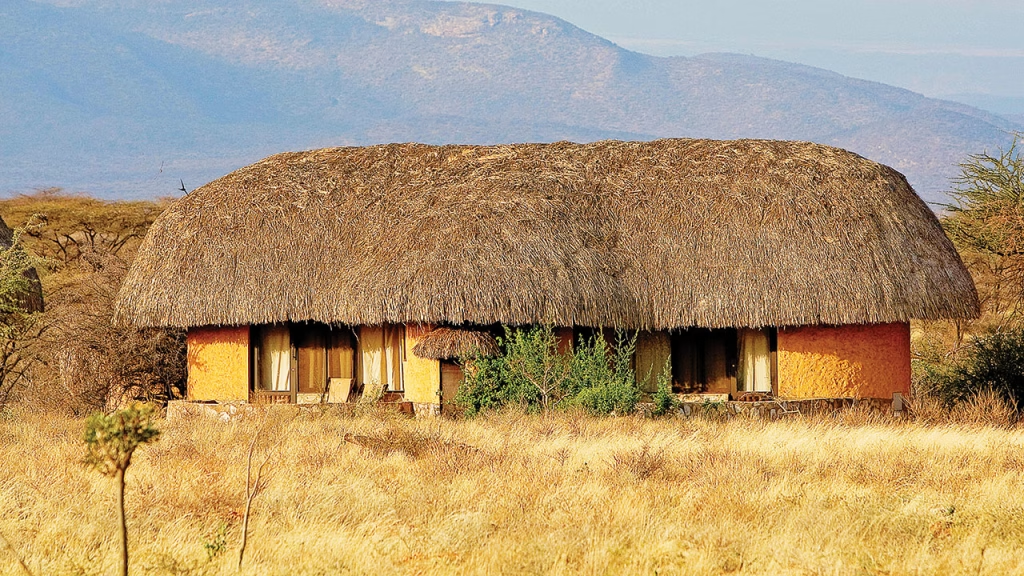
Samburu offers a dramatic contrast to the Mara. The landscape is drier, more rugged and shaped by the Ewaso Nyiro River. It is known for species that are less commonly encountered farther south, including Grevy’s zebra, reticulated giraffe, Somali ostrich, gerenuk and Beisa oryx.
For travelers who want wildlife variety rather than a single migration-focused safari, the north gives a Kenya itinerary greater depth. It is particularly rewarding for photographers, repeat safari guests and travelers interested in landscapes as much as large concentrations of animals.
Ol Pejeta: conservation and rhino

Ol Pejeta adds a conservation dimension to a Kenya journey. It is a strong choice for guests interested in rhino, chimpanzee conservation, private conservancy management and a different style of game viewing from the Mara.
It can also break up a road route between Nairobi and northern Kenya, or fit naturally into a fly-in circuit. For families and multigenerational groups, this variation in habitat and activity can make a longer itinerary feel more balanced.
The Rift Valley: lakes, birdlife and a change of pace
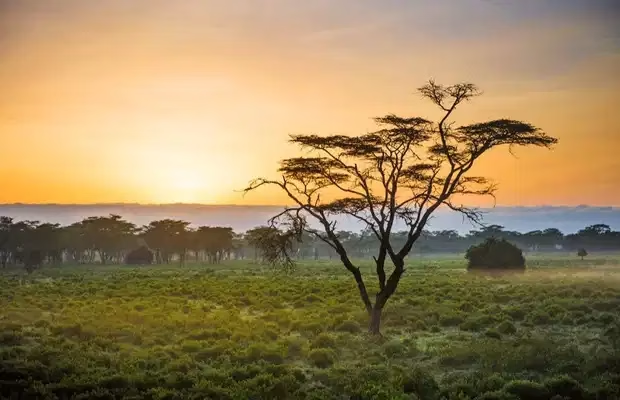
Lake Nakuru, Lake Naivasha and surrounding Rift Valley landscapes introduce another side of Kenya: lakeshore scenery, birdlife, boat excursions, walking opportunities in appropriate areas and a welcome visual change from open savannah.
Not every itinerary needs all of these locations. The aim is not to collect parks. It is to create contrast while giving each stop enough time to be meaningful.
Amboseli: elephants and Kilimanjaro views

Amboseli is a compelling addition for travelers who want to see large elephant herds against the backdrop of Mount Kilimanjaro when conditions allow. It pairs particularly well with the Maasai Mara for a first Kenya safari because the landscapes, wildlife viewing and photographic opportunities feel distinct.
Maasai Mara: big cats and migration-season drama

The Maasai Mara remains one of the most compelling conclusions to a Kenya circuit. It offers open grasslands, abundant resident wildlife and some of East Africa’s most celebrated big-cat viewing.
During the annual migration period, typically associated with July to October in the Mara, it may also host large herds of wildebeest and zebra moving through the wider ecosystem. River crossings remain unpredictable, however. They are driven by herd movement, rainfall, water levels and animal behavior—not by an itinerary date.
Our 14-day Kenya safari shows what a deeper country-wide circuit can look like, linking Nairobi, Ol Pejeta, Samburu, Mount Kenya, Lake Nakuru, Lake Naivasha and the Maasai Mara. This is the kind of route that gives each ecosystem a clear role rather than treating Kenya as a brief stop before moving on.
When a second country adds real value
A multi-country East Africa safari should begin with a specific reason to cross a border.
“Seeing more countries” is not, by itself, a good enough reason. The strongest itineraries are built around experiences that are genuinely distinct and personally important.
Kenya and Tanzania: Mara, Serengeti and Ngorongoro
A Kenya-and-Tanzania itinerary is the most natural multi-country safari combination. The Maasai Mara and Serengeti are connected ecosystems, but they are not interchangeable. The Serengeti offers exceptional scale and different seasonal migration perspectives, while the Ngorongoro Conservation Area brings a distinctive crater setting and a different wildlife-viewing rhythm.
This route is best for travelers who:
- Have at least 12 to 14 days available
- Want to experience both sides of the wider migration ecosystem
- Are comfortable with additional flights or a cross-border road transfer
- Are prepared for higher total costs and more logistical detail
- Value a broader regional story over a slower Kenya-only itinerary
A 10-day Kenya-and-Tanzania safari can work, but only if it is tightly focused. Attempting Nairobi, Amboseli, Maasai Mara, Serengeti, Ngorongoro and Zanzibar in 10 days usually creates too many transitions and too few full safari days.
The Serengeti borders Kenya’s Maasai Mara to the north, allowing wildlife to move through the wider ecosystem during the migration. That ecological continuity is one reason the combination is compelling—but it does not remove the practical travel steps required for guests crossing from Kenya into Tanzania.
Kenya and Zanzibar: safari plus beach
A Kenya-and-Zanzibar itinerary is ideal for travelers who want to end a wildlife-focused holiday with several nights by the ocean. This is particularly popular for honeymooners, couples, and guests who prefer a balance between early safari mornings and unstructured beach time.
The key is to protect the safari portion of the trip. We generally recommend at least six to eight nights in Kenya before adding a beach stay, depending on how many regions you hope to cover. A three-night safari followed by a long beach extension can be enjoyable, but it is not the same as a deeper East Africa safari.
Kenya and Uganda or Rwanda: safari plus gorillas
Gorilla trekking is one of the clearest reasons to build a multi-country East Africa itinerary. It is not a substitute for a savannah safari; it is a wholly different wildlife encounter involving forest terrain, permits, hiking, and a more physically demanding day.
For travelers who value wildlife diversity and have 12 to 14 days, Kenya plus Uganda or Rwanda can be exceptional. But it needs careful planning around internal flights, trekking permits, fitness level, and luggage.
The East African Tourist Visa can simplify entry for eligible travelers visiting Kenya, Uganda and Rwanda. It is valid for tourism travel between those three countries for up to 90 days and costs USD 100, but it does not include Tanzania. Travelers must apply through the country of first entry and should always confirm requirements for their passport before booking.
Two routes, compared honestly
The following examples show how a 14-night holiday can be allocated. They are planning patterns, not fixed packages; we will tailor camp selection, vehicle format and flight arrangements around your dates and priorities.
Option 1: A 14-night Kenya-only circuit
| Destination | Suggested nights | Why it earns its place |
|---|---|---|
| Nairobi | 1 | International arrival, recovery and a smooth start |
| Samburu | 3 | Northern landscapes and specialist wildlife |
| Ol Pejeta | 2 | Rhino conservation and varied conservancy experience |
| Lake Nakuru or Lake Naivasha | 2 | Rift Valley scenery, birdlife and a change of pace |
| Maasai Mara | 4 | Big cats, open plains and extended game-viewing time |
| Nairobi | 1 | International departure buffer |
| Flexible routing or extra Mara / Amboseli night | 1 | Protects pace and allows the route to reflect the traveler’s priorities |
This itinerary provides room for full game-drive days rather than treating each destination as a one-night stop. It also makes it easier to adjust transport: road travel can work on selected sections, while domestic flights can be used where they save substantial time.
Option 2: A 14-night Kenya and Tanzania safari
| Destination | Suggested nights | Why it earns its place |
|---|---|---|
| Nairobi | 1 | Arrival and pre-safari night |
| Maasai Mara | 3 | Kenya’s classic grassland safari experience |
| Transfer / regional flight | 1 | A realistic allowance for cross-border logistics |
| Serengeti | 3 | Broad plains and a different migration ecosystem perspective |
| Ngorongoro / Karatu | 2 | Crater access and a change of landscape |
| Zanzibar | 3 | Beach extension and time to slow down |
| Departure routing | 1 | Ensures the journey does not rely on an unrealistic same-day international connection |
The second itinerary is broader, but it has fewer full wildlife days in each area. It works for guests whose priority is the combination of Mara, Serengeti, Ngorongoro and coast. It is not automatically superior to the Kenya-only route; it simply answers a different travel ambition.
What changes the quote?
A multi-country itinerary is usually more expensive than a Kenya-only safari, but the size of the difference varies significantly.
The major cost drivers are not only accommodation rates. They include the number of domestic or regional flights, park and conservancy fees, one-way vehicle transfers, entry authorizations, private guiding, room category and the number of nights spent at high-demand properties.
Kenya-only cost drivers
- Camp or lodge level and location
- Private versus shared vehicle
- Domestic flights versus road transfers
- Park and conservancy fees
- Number of destinations and transfer distances
- Room category, family arrangements and single supplements
- Optional experiences such as ballooning, guided walks or cultural visits
Multi-country cost drivers
- All Kenya-only factors, plus:
- Regional flights or cross-border road transfers
- Separate park fees and conservation fees in each country
- Additional guiding teams, vehicles and operating partners
- Visas, electronic travel authorizations or permits
- Gorilla permits, where relevant
- One-way routing and additional baggage considerations
- Extra arrival or departure nights required to make the route sensible
Entry rules can change. Kenya requires most international visitors to obtain an approved Electronic Travel Authorization before travel, with specific exemptions and eligibility rules. We will guide you on the planning process, but each traveler remains responsible for meeting the current requirements for their own nationality and passport.
Do you lose safari time at borders?
You can, especially on an itinerary that relies on overland cross-border travel.
The issue is not merely time spent at immigration. It includes packing, departure from camp, road distance to the border, formalities, changing vehicles or guides where necessary, onward driving, and arrival procedures at the next accommodation. Even a smoothly managed transfer can consume a meaningful part of the day.
That does not mean overland border travel should be avoided. It can be a practical and scenic option for the right itinerary. But it should be treated honestly as a transfer day—not marketed as a full game-drive day with a quick border stop in the middle.
For travelers with limited time, regional flights can protect more safari hours. They increase the cost but often create a more relaxed journey. We assess this trade-off case by case.
Which option is better for a first safari?
For most first-time visitors with 10 to 14 days, we recommend a Kenya-only safari.
Kenya provides enough variation to make a first safari feel comprehensive: multiple ecosystems, varied wildlife, conservation experiences, high-quality camps and lodges, and the option to combine road travel with bush flights. A deeper Kenya itinerary also gives you time to understand the rhythm of safari—early starts, long quiet wildlife sightings, changing weather, camp life and the pleasure of not needing to rush onward every morning.
A multi-country route is the stronger choice when the second country contains a true priority:
- You have always wanted to see the Serengeti.
- A Zanzibar beach stay is essential to your holiday.
- Gorilla trekking is a must, not an optional add-on.
- You are returning to East Africa and want a broader regional comparison.
- You have 14 days or more and are comfortable paying for extra logistics.
How we design the right East Africa safari
We begin with what matters most to you, not with a pre-set list of countries.
Tell us whether your priority is migration wildlife, big cats, elephants, rare northern species, conservation, photography, gorilla trekking, a beach extension, family travel or a relaxed luxury pace. We will then recommend the number of countries that adds value rather than complexity.
Choose a Kenya-only safari if you want deeper wildlife time, fewer transitions and a varied 10- to 14-day itinerary that does not feel rushed.
Choose a multi-country East Africa safari if a specific experience in Tanzania, Uganda or Rwanda is important enough to justify additional transfers, costs and planning.
You can explore our East Africa safari attractions for destination inspiration, then compare them against the more detailed route logic in our 8-day Kenya safari and 14-day Kenya safari.
Compare Kenya and East Africa itineraries
A better safari is not the one that crosses the most borders. It is the one that gives you enough time in the landscapes and wildlife areas you care about, with realistic transfer days and the right standard of guiding and accommodation.
Share your travel dates, group size, budget range, and must-have experiences with us. We will build a clear Kenya-only and multi-country option where appropriate, showing the nights, flights, transfer requirements, inclusions and trade-offs before you decide.
Contact our safari specialists to compare tailored Kenya and East Africa safari itineraries, or message us on WhatsApp to begin planning.
FAQs
Is 10 days enough for Kenya and Tanzania?
It can be, but only with a focused itinerary. A well-designed 10-day trip might combine the Maasai Mara with the Serengeti and Ngorongoro, but it will involve several transfers and fewer nights in each location. For a more relaxed Kenya-and-Tanzania experience, we recommend 12 to 14 days.
Is a multi-country safari much more expensive?
Usually, yes, because regional flights, additional park fees, border logistics, extra guide and vehicle arrangements, and one-way routing add cost. The final difference depends on accommodation level, season, travel style, and the countries included. We will provide a like-for-like comparison rather than a headline price alone.
Do travelers lose safari time at the Kenya–Tanzania border?
They can. Border travel includes road transfers, immigration procedures, possible vehicle or guide changes, and onward travel to the next camp. It should be planned as a genuine transfer day. Flights can reduce travel time but may increase the overall itinerary cost.
Which option is better for a first safari?
For most first-time travelers with 10 to 14 days, a Kenya-only safari offers better depth, simpler logistics, and more time in wildlife areas. A multi-country safari is the better choice when you have a specific priority—such as the Serengeti, Zanzibar or gorilla trekking - that Kenya alone cannot provide.